

KICK develops ESPM's first Sustainability Report

ESPM has published its first Sustainability Report, with governance, social and environmental data for 2025, and KICK Group provided the consulting and technical coordination of the report. Founded in 1951 as Escola de Propaganda de São Paulo, ESPM now has about 12,000 active students and campuses in São Paulo, Rio de Janeiro, Porto Alegre, Florianópolis and Curitiba. The report uses the GRI Standards as a reference and also relates to the assessment instruments of Brazil's Ministry of Education (MEC), the Ethos Indicators and the Sustainable Development Goals (SDGs). For an educational institution, a first report organizes what already exists and shows what still needs to be measured.
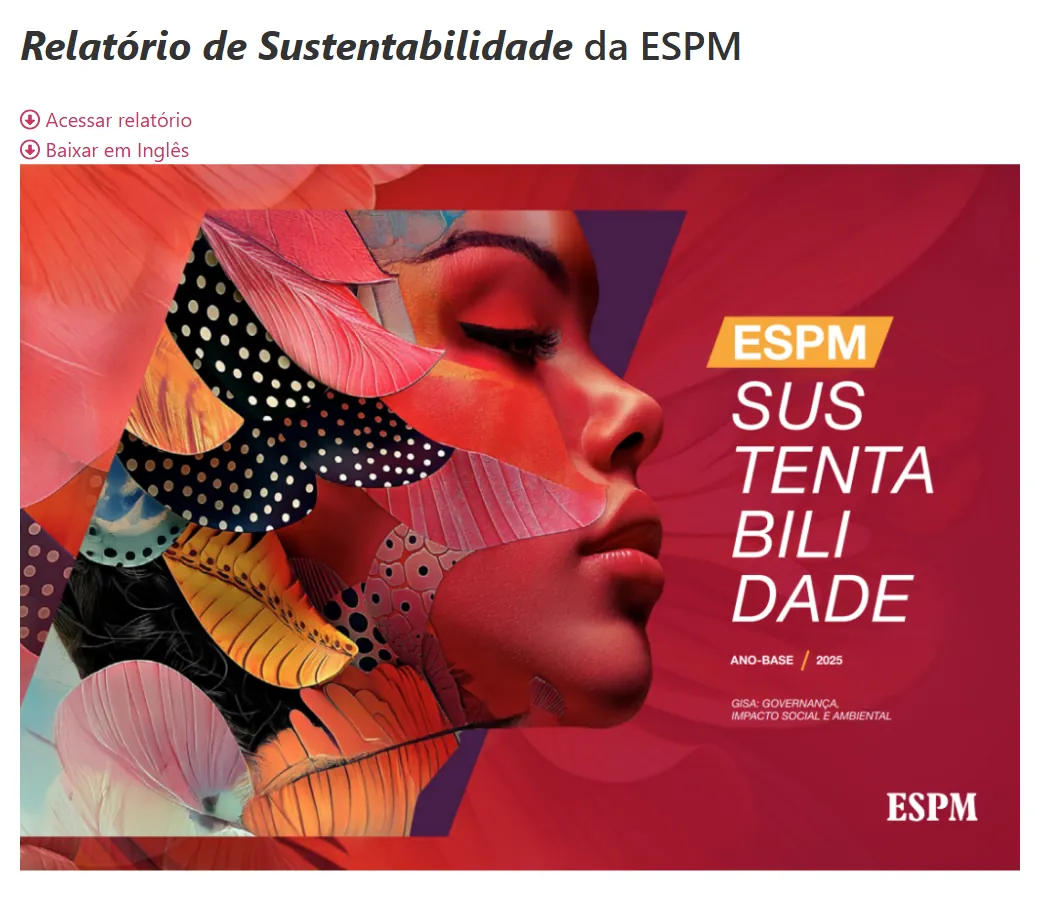
A first report
The document covers January 1 to December 31, 2025. It uses the Global Reporting Initiative (GRI) Standards to structure topics and indicators, without a full statement of compliance, as is common in a first cycle. The report itself says some indicators are still being consolidated and that the process helped identify gaps and opportunities to improve management and reporting.
The agenda is led by the GISA Committee (Governance, Social and Environmental Impact), created in 2024, chaired by ESPM's president, Dalton Pastore, and coordinated by the ESPM Center for Socio-environmental Development (CEDS) together with the Corporate Governance, Risk and Compliance team. In 2025, the institution also defined the methodology for its first materiality study, consulting faculty, students, staff, alumni, suppliers and the community, from a double materiality perspective.
The education sector in the report
One of the project's choices was to link each chapter to three references at once. Besides the GRI indicators, topics show their relationship with MEC's institutional assessment instruments, already part of the routine of a higher education institution, with the Ethos Corporate Social Responsibility Indicators and with the SDGs. This way the report speaks both to those who assess academic quality and to those who follow the ESG agenda, and the index at the end of the document cross-references all four frameworks.
The content is organized into six chapters:
- Ethics, integrity and compliance;
- People, careers and knowledge;
- Health, safety and well-being;
- Diversity, inclusion and human rights;
- Education that transforms;
- Sustainable agenda: from management to research.
What the report shows
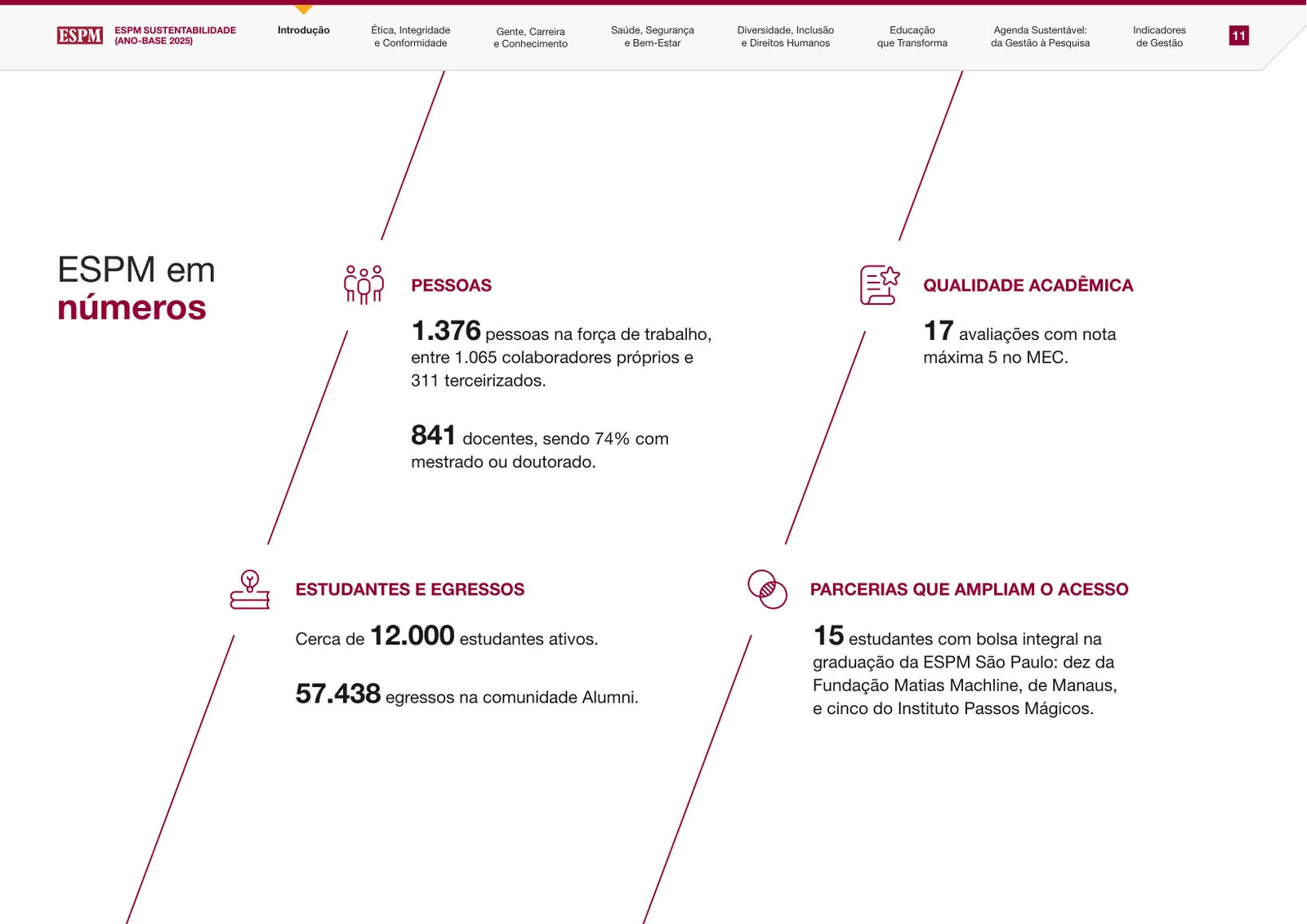
Among the 2025 figures:
- People: 1,376 people in the workforce, including 1,065 direct employees and 311 contractors, and 841 faculty members, 74% with a master's or doctorate.
- Academic quality: 17 top scores (5) in MEC assessments, about 12,000 active students and 57,438 alumni.
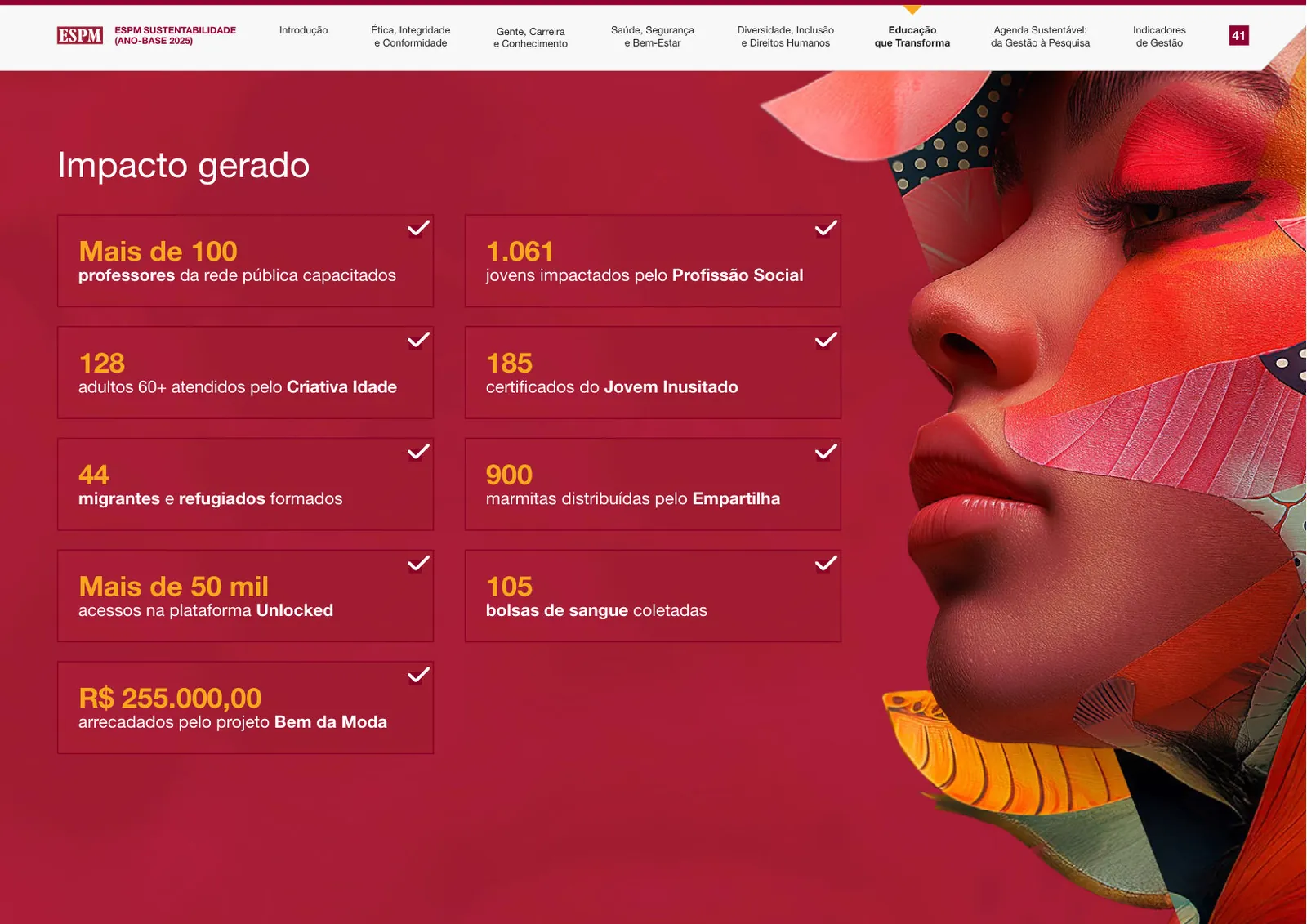
- Listening: 100% of reports handled, 470 through the Ombudsman and 13 through the Ethics Channel.
- Human rights: zero violations recorded in security activities, and contract clauses against child labor and slave-like labor.
- Climate: a first greenhouse gas inventory, with 395.918 tCO₂e in base year 2025.
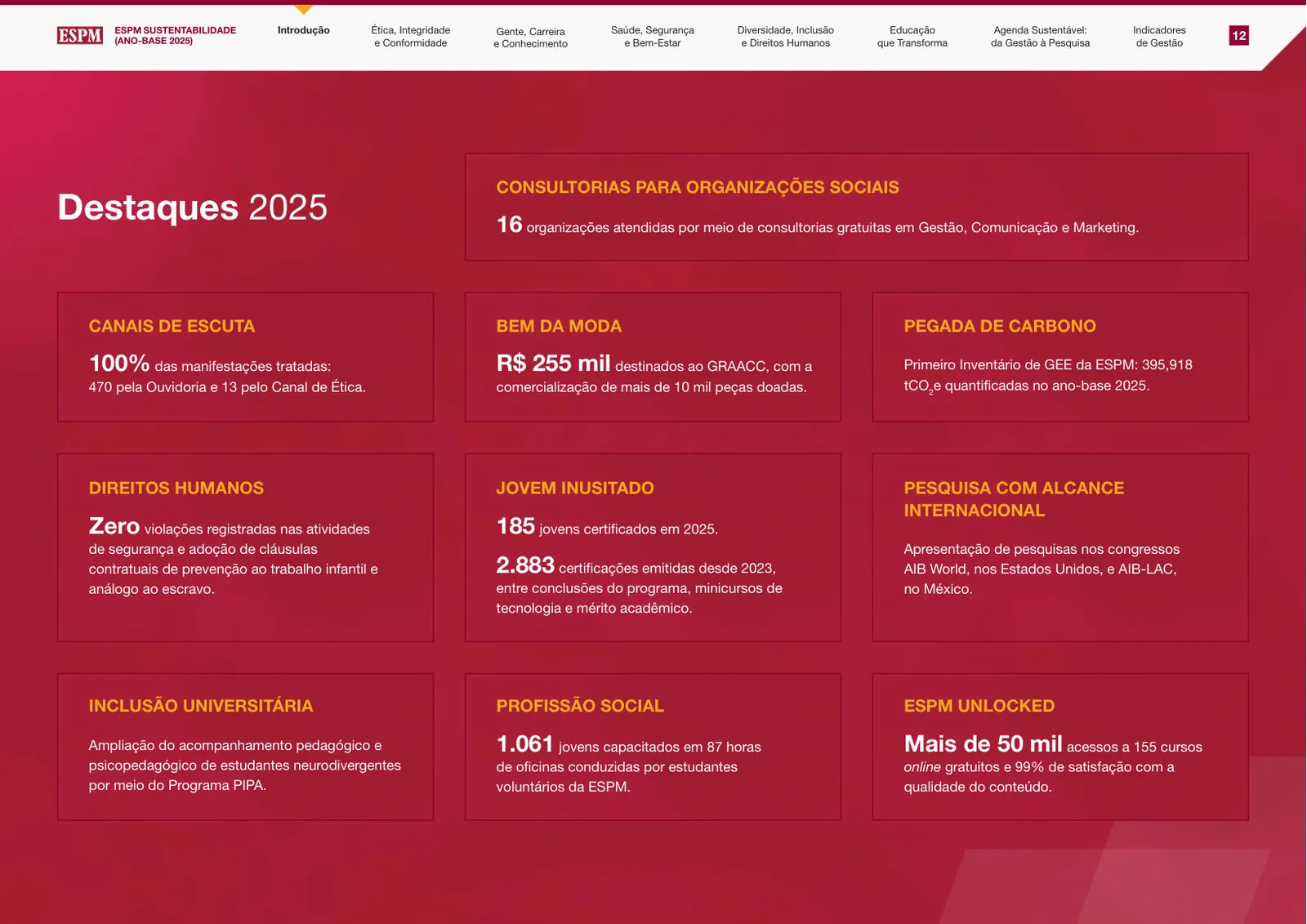
The "Education that transforms" chapter brings together ESPM's work beyond the classroom. In 2025, Profissão Social trained 1,061 young people in 87 hours of workshops led by student volunteers, Jovem Inusitado certified 185 young people, Criativa Idade served 128 adults over 60, and 44 migrants and refugees completed training. The ESPM Unlocked platform had more than 50,000 accesses to 155 free online courses, and the Bem da Moda project raised R$255,000 for GRAACC, a children's cancer charity, through the sale of donated clothing.
The first emissions inventory
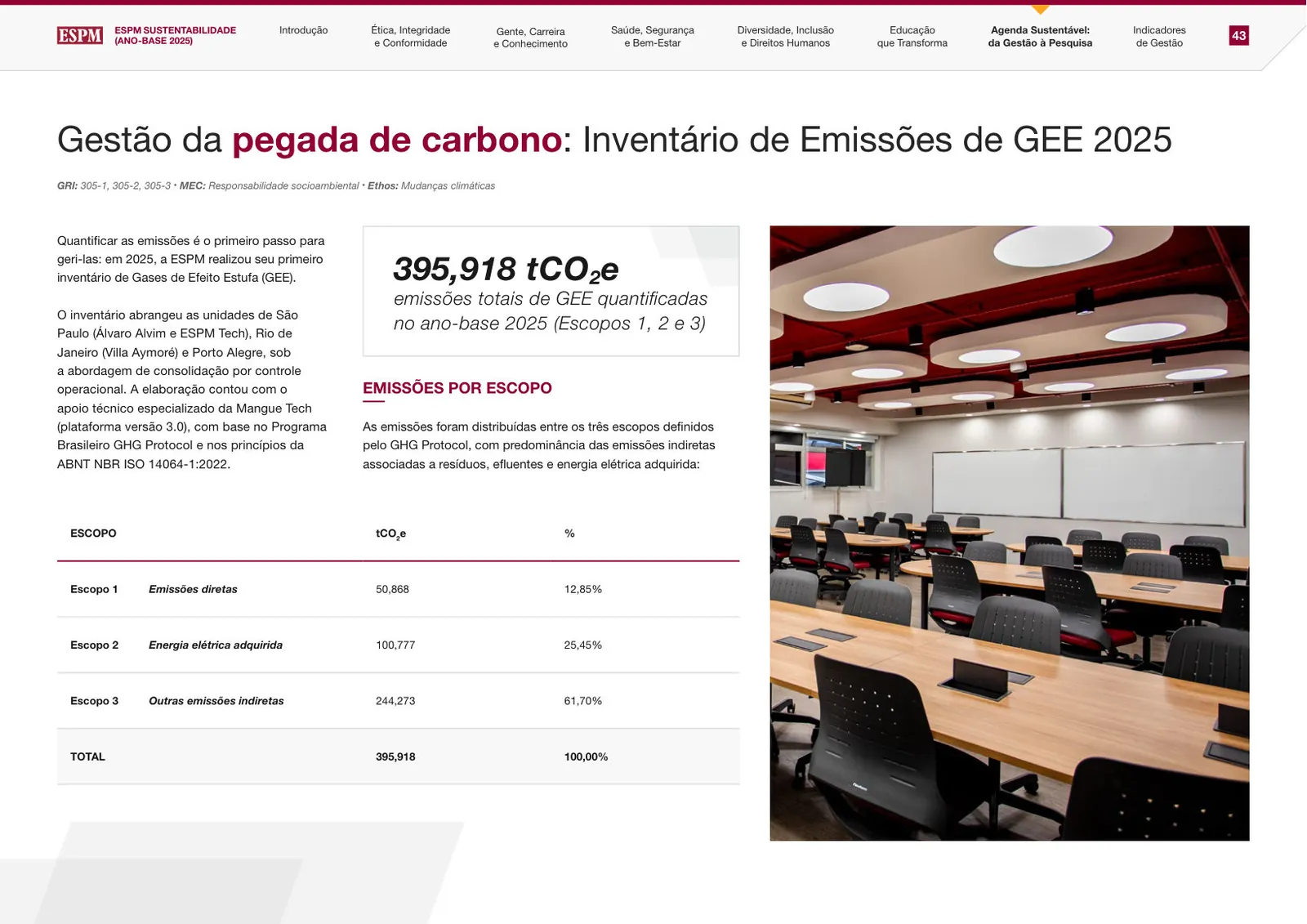
The report includes ESPM's first greenhouse gas inventory, covering the São Paulo, Rio de Janeiro and Porto Alegre campuses under the operational control approach. The total was 395.918 tCO₂e: 12.85% in scope 1 (direct emissions), 25.45% in scope 2 (purchased electricity) and 61.70% in scope 3 (other indirect emissions, driven by waste and wastewater). The calculation followed the Brazilian GHG Protocol Program and ABNT NBR ISO 14064-1:2022, using the Mangue Tech platform, with technical inventory consulting within the report team.
How KICK worked
KICK gathered and systematized the information provided by ESPM's departments, structured the content around the chosen frameworks and coordinated the report through to publication. The work included:
- ESG consulting and technical coordination of the report;
- report management and data intelligence;
- content, editing and data systematization;
- technical consulting for the greenhouse gas inventory;
- graphic design, layout and proofreading.
On ESPM's side, coordination and technical responsibility were led by Marcus Nakagawa, with the GISA Committee and more than twenty of the institution's professionals providing technical and content support. It is the kind of project where the consultancy organizes the path, but the report depends on the people who know the operation from the inside.
What a first report leaves behind
A first sustainability report creates a baseline. From it, ESPM can compare indicators year on year, prioritize topics through the materiality study and close the gaps the process itself identified. Educational institutions have an added advantage: much of the information already exists because of MEC assessments, and the report helps organize it in language that students, families, partners and the market understand.
The full report is available on the ESPM website (in Portuguese), and the ESG = GISA page lists the programs and links to the English version.
Talk to KICK
KICK Group guides organizations through the ESG journey, from data collection and analysis to sustainability reports in international standards such as GRI, including materiality and emissions inventories. If your institution is preparing its first report, it is worth talking.
Write to contato@kickgroup.com.br. Source: ESPM Sustentabilidade (base year 2025), in Portuguese, and ESPM's ESG = GISA page. Images: reproduced from the report and the ESPM website. Text updated to November 20, 2026.
Keep reading

A sustainability report treated as a campaign becomes a liability
When the report is born from the communication calendar, the image runs ahead of the data. See why this is a risk, what technical readers notice and how to build the cycle that supports reporting.
GRI expands its presence in Brazil: what changes in companies' sustainability reporting
With new climate, energy and biodiversity standards, regulatory changes and pressure on SMEs and supply chains, sustainability reporting enters a new phase in Brazil.
Letter at COP31 calls for political leadership to end deforestation by 2030
More than one hundred organizations, Indigenous peoples and research institutions call for an implementation process through 2030 and an international meeting in 2027. See what the letter says, the COP30 Roadmap and what changes for companies.