

Climate and nature scenarios enter the agenda of finance ministries
The French Development Agency (AFD) published, in June 2026, Policy Paper No. 21, authored by Jeffrey Althouse, Bastien Bedossa, Etienne Espagne, William Hynes, Jean-François Mercure and Nadia Sidzanbnoma Ouedraogo. The document argues that ministries of finance, public development banks and financial authorities have taken on a central role in the post-COP30 agenda and today lack tools equal to it. The proposal is a type of analysis called Climate and Nature Economic Policy Scenarios (CNEPS). A draft was presented at an AFD-OECD workshop on December 10, 2025.
The problem the paper describes
According to the authors, climate and nature-loss risks have stopped being peripheral issues and now affect macroeconomic stability, fiscal sustainability, debt, inflation and development prospects. At the same time, the transition takes place under uncertainty: geopolitical fragmentation, tighter financial conditions, uneven technological change and more intense physical impacts.
Ministries' tools, such as budget analysis, debt sustainability analysis, macroeconomic forecasting models and cost-benefit analysis, were developed, the text says, for relatively stable environments. They rely on historical relationships, linear dynamics and marginal changes around a baseline, and so miss systemic shocks and cascading effects. The paper cites a survey by the Coalition of Finance Ministers for Climate Action (CFMCA, 2025) according to which only 6% of ministries face no major obstacles to integrating climate and nature into economic analysis.
The scenarios that already exist, especially those produced for central banks, also have limits for this audience. They aim at stress-testing financial stability rather than macroeconomic strategy, and tend to use smooth adjustment pathways and a constrained representation of uncertainty.
What CNEPS are
CNEPS are scenarios designed to link macroeconomic planning, fiscal policy and environmental objectives. The paper describes them through five features.
- Distribution of risks and opportunities. Instead of only the most likely path, they look at the full range of outcomes, including low-probability, high-impact events.
- Integration of dynamics. Climate shocks, energy transition, debt and disruptions in global markets enter the same analysis.
- Adaptation to country context. Sector structure, exposure to physical risks, financing constraints and political economy enter the assumptions.
- Scalability. They can be applied from qualitative narratives and stress tests to more advanced integrated models, depending on each country's capacity.
- Co-construction. The design involves ministries of finance, central banks, public development banks, sector ministries and international partners.
The central idea is to move ministries from the position of "scenario-takers", who use assumptions from global models, to "scenario-makers", who define assumptions, narratives and policy mixes that fit their own economy.
The right moment in the policy cycle
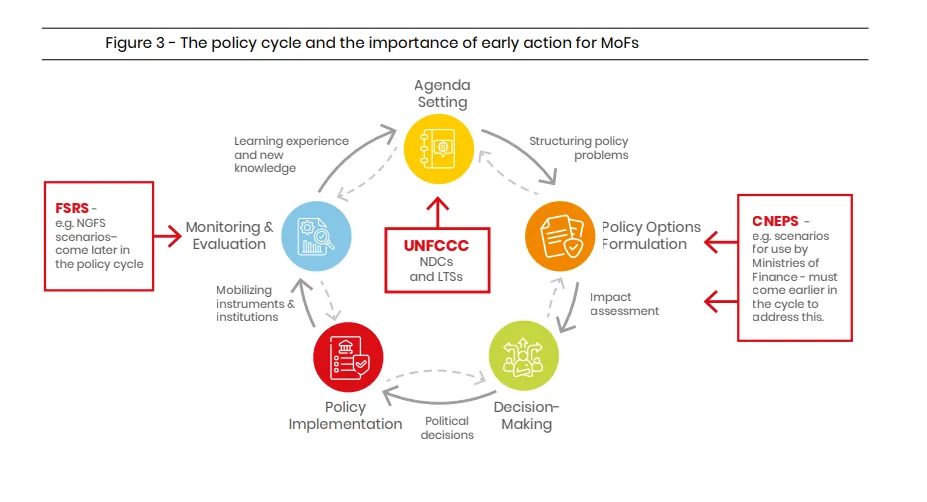
Figure 3 of the paper shows why timing matters. Policies go through agenda setting, structuring of the problem, formulation of options, decision-making, implementation and monitoring. UN climate convention commitments, such as NDCs and long-term strategies, feed agenda setting. The scenarios used by financial supervisors, such as those of the NGFS network (FSRS), arrive later in the cycle. CNEPS need to arrive earlier, in policy options formulation and impact assessment, when choices are still open.
The recommendations
The paper brings together six recommendations for ministries.
- Integrate scenario analysis into core processes. The annual budget, the medium-term fiscal framework and debt analysis should take in scenarios as routine, with a responsible unit and annual or biennial review cycles.
- Be a scenario-maker. Build own assumptions, with the participation of sector ministries, public development banks, planning bodies and, where appropriate, central banks. For the authors, the process of building is almost as important as the result.
- Look at extreme risks. Extreme climate events, technological disruptions, geoeconomic shifts and tipping points should be treated as structured stressors.
- Go beyond risks. Compare policy mixes, sequencing and trade-offs. The text gives as examples fossil fuel subsidy reform combined with targeted social protection, and the question of whether front-loading adaptation investment costs less than repeated spending after disasters.
- Strengthen coordination. With central banks, public development banks and sector ministries, without working in silos.
- Cooperate at regional scale. Many risks, such as food price shocks, droughts, hydropower failures and transport bottlenecks, cross borders.
The text's table of applications shows that scenarios should feed the appraisal of public investment projects and the dialogue with development banks, with attention to project structuring, concessionality, guarantees and blended finance, so that choices are fiscally sound and bankable. It also cites the use of scenarios to avoid stranded assets and to engage multilateral banks, investors and rating agencies.
For companies and developers, this suggests three points of attention.
- Projects will be tested against more than one future. A project that only holds in the most likely scenario tends to be viewed with more reserve by those who finance and plan. Showing how the project behaves under drought, flood, price shock or regulatory change helps support the decision.
- Social cost enters the account. The paper notes that workers in carbon-intensive sectors and lower-income populations tend to feel adjustments more and that lack of support can erode public trust. For those operating in the territory, mapping who gains and who loses from the project and sustaining dialogue with communities is part of a realistic scenario.
- Information needs to circulate early. The logic of figure 3 holds for the private project: the decision on location, technology and design comes before the license, and that is where risks and opportunities are cheapest to address.
Caveats
The text is a policy paper, a method proposal by authors linked to AFD and academic institutions, and uses the conditional when describing CNEPS, which "potentially" offer a structured approach. It is neither a norm nor a government commitment. The authors themselves note that scenario building is never purely technical: the choice of participants, boundaries and assumptions reflects power relations and needs to be negotiated transparently.
Talk to KICK
KICK Group works on socio-environmental communication and stakeholder engagement for projects, from diagnosis to monitoring. If your project needs to show risks, impacts and its relationship with the territory to lenders and public bodies, it is worth talking.
Write to contato@kickgroup.com.br. Source: AFD, Policy Paper No. 21 (June 2026). Informational text, updated as of November 9, 2026.
Keep reading

Norway commits R$350 million to the Amazon Fund after deforestation drop
The new Norwegian contribution, what the Amazon Fund is, who donates, the calls made so far, for how much and for whom, and Norway's record with the Fund and the TFFF.

Green Climate Fund announces US$1 billion for 14 Pacific countries: what is at stake
Marie-Ange Saraka-Yao announced in Perth a pipeline of climate investments with 14 Pacific countries, later approved. Understand the numbers, the programme design and what it says about climate finance.

KICK develops ESPM's first Sustainability Report
The report, with 2025 data, uses the GRI Standards as a reference and relates to MEC assessments, the Ethos Indicators and the SDGs. See how it was developed and what it shows.