

In the 2027 budget, only R$6 million of the Climate Fund is non-reimbursable

The 2027 Annual Budget Bill (PLOA), sent to Congress on August 31, provides R$61.5 billion for Environmental Management, a 22.7% real increase over 2026. The math, however, has a catch. The Observatório do Clima, working with the Environmental Parliamentary Front, analyzed the proposal and concluded that the growth rests on money that must be paid back, while the non-reimbursable part remains very small.
What the publication analyzes
The report (in Portuguese), published in October 2026, was prepared with the Climate and Budget working groups of the Environmental Parliamentary Front. It covers the Climate Fund, the National Environment Fund (FNMA), the environmental and climate budget in general and the role of parliamentary amendments, and ends with amendment recommendations.
The context is a tight budget. The 2027 primary spending cap reaches R$2.576 trillion, 7.7% above 2026, but 91.7% of it is already committed to mandatory spending. It is also the last year of the 2024-2027 Multiyear Plan and the first budget bill after the 2024-2035 Climate Plan. The question the document asks is whether there are resources to deliver what was planned.
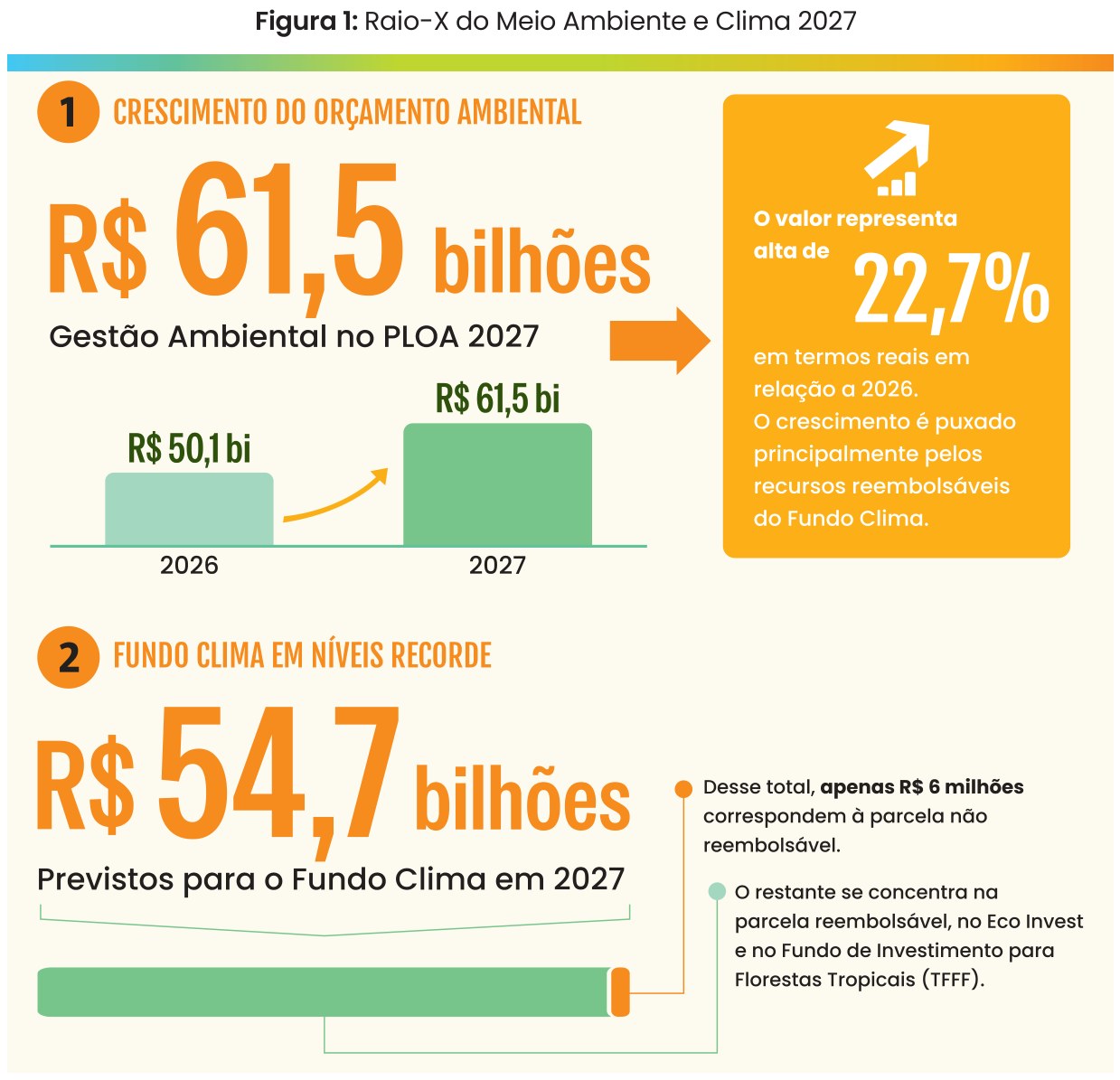
The Climate Fund grows, and the non-reimbursable part stays at R$6 million
Created by Law 12,114/2009, the Climate Fund is Brazil's main climate finance instrument. Resources planned for it went from R$637.8 million in 2023 to R$54.7 billion in the 2027 bill, and the rise came almost entirely from the reimbursable part, that is, loans that must be repaid. In 2027, there are R$29.7 billion in the reimbursable portion, R$20 billion in Eco Invest and R$5 billion in the Tropical Forests Investment Fund. The non-reimbursable portion, managed by the Ministry of Environment, has R$6 million, about 0.01% of the total.
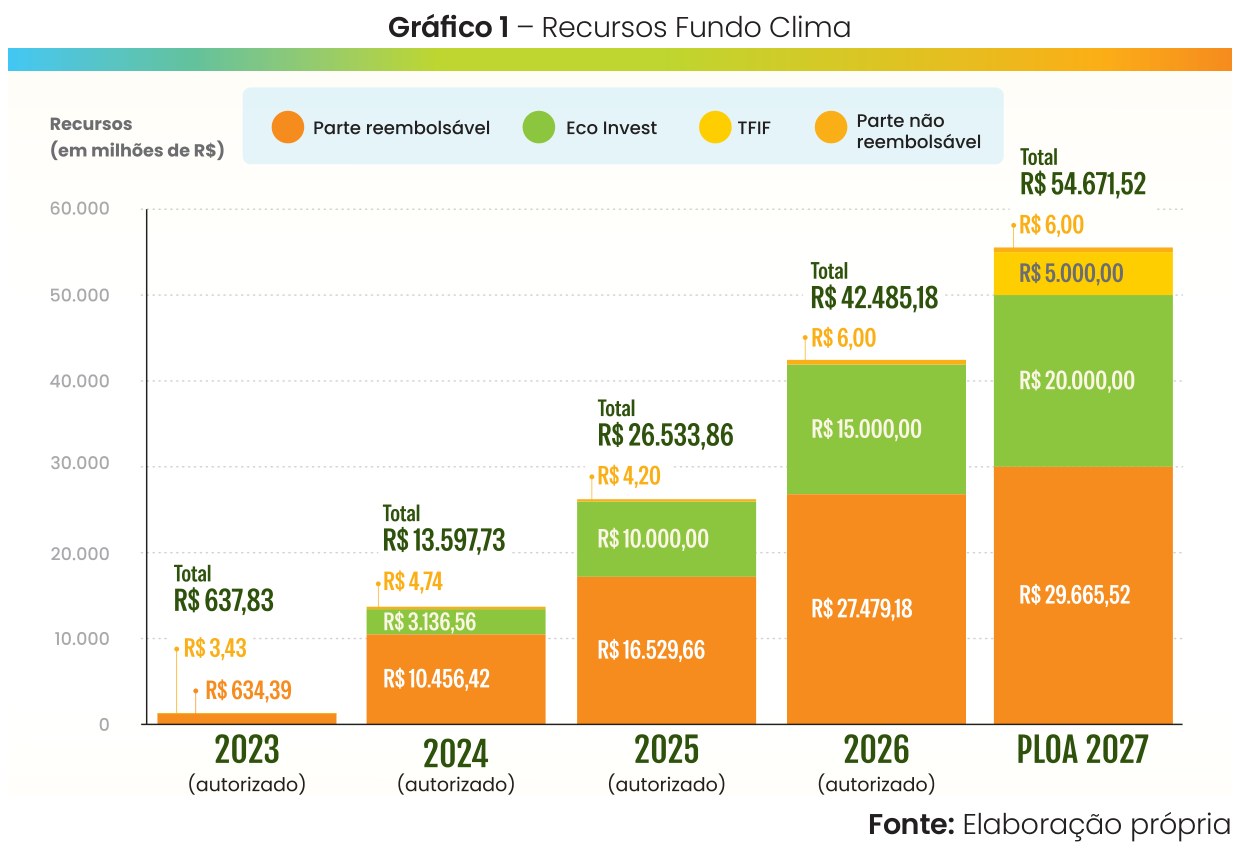
According to the report, the bottleneck lies in what is missing: grant money and reach, especially for vulnerable territories and municipalities with little fiscal capacity. Eco Invest, which mobilizes private capital with currency protection, goes in the same direction, with R$3.1 billion in 2024, R$10 billion in 2025, R$15 billion in 2026 and R$20 billion in the 2027 bill.
Who gets the money
The 2025 numbers show the design in practice. The Climate Fund approved R$12.55 billion in operations, and 78% of that, R$9.80 billion, went to large companies. Micro, small and medium-sized companies got 22%, R$2.75 billion. Among recent beneficiaries, the report cites Sigma Mineração, Raízen and São Martinho, with operations of up to R$500 million.
The trend is likely to widen. In September 2026, the National Policy on Critical and Strategic Minerals (Law 15,506/2026) was signed, authorizing BNDES to use reimbursable Climate Fund resources to finance processing, mineral transformation and urban mining of those minerals. The energy transition depends on them, so the report calls for attention to which sectors and companies will receive these funds.
The FNMA and the contingency reserve
The National Environment Fund, created in 1989 to support preservation and conservation projects, shows another kind of problem, money that exists and does not go out. In the 2027 bill, about 86% of FNMA resources sit in the contingency reserve, and only R$17.9 million, 13.5% of the total, go directly to projects. The reserve falls R$141.75 million compared with the 2026 bill, but resources for projects rise by only R$50,000.
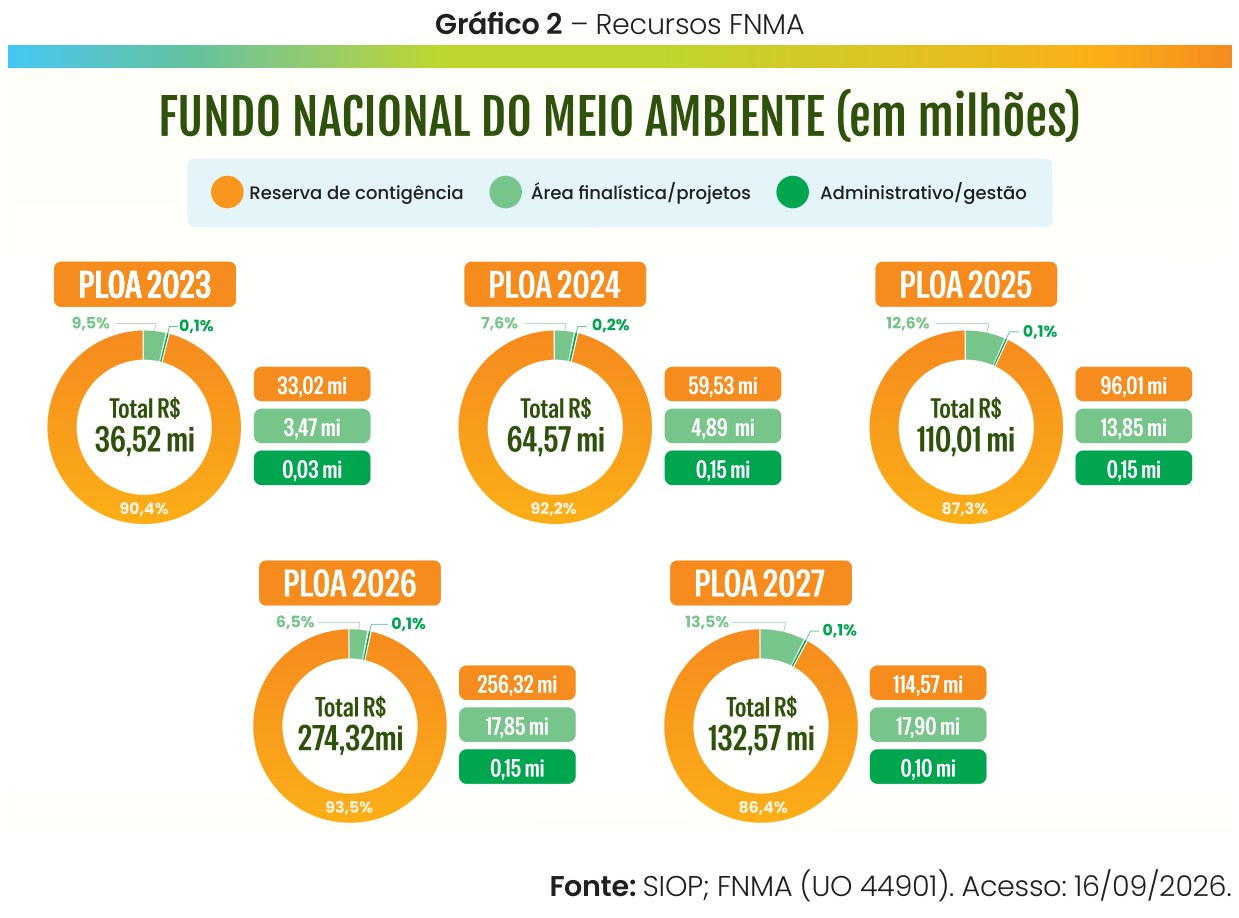
Execution is also low. Of the R$13.85 million planned for the project area in 2025, only R$1 million was actually paid. In 2026, R$3.05 million of the R$17.85 million planned was paid. The report recommends expanding the share for projects, reducing the reserve and ensuring that environmental fines provided for by law are transferred to the fund.
Where the environmental budget goes
The R$61.5 billion for Environmental Management grows at a slower pace than in the two previous years, when the increase was 63.7% in 2025 and 75.5% in 2026, and the push comes mainly from the reimbursable part of the Climate Fund. The budget of the Ministry of Environment and Climate Change (MMA) itself is much more modest. Planned at R$4.92 billion, it has a real increase of 4% over the 2026 bill, represents about 0.37% of the total of the 30 ministries analyzed and ranks 20th. The Ministry of Social Development, by comparison, has R$324.3 billion planned, about 66 times more.
Among the selected environmental and climate actions, 15 gained resources, three lost and one is new. Bolsa Verde, environmental enforcement, fire prevention and protected areas account for about 80% of the increase. On the loss side, the action for purification and desalination of waters falls from R$60 million to R$15 million, a 75% drop, enforcement against illegal deforestation in the Amazon loses R$12.9 million and the biodiversity, native vegetation and protected areas action loses R$4.78 million. Agrarian Development Ministry resources for the energy transition fall 16.9%, from R$2.90 million to R$2.41 million.
The weight of parliamentary amendments
Individual amendments became mandatory in 2015, with Constitutional Amendment 86, and bench amendments in 2019, with EC 100. The amount authorized by Congress jumped from R$9.7 billion in 2015 to R$49.9 billion in 2026, more than fivefold. The biggest leap was from 2022 to 2023, from R$17.1 billion to R$35.8 billion. For 2027, the bill reserves R$44.8 billion for mandatory amendments, R$28.5 billion individual and R$16.3 billion from benches.
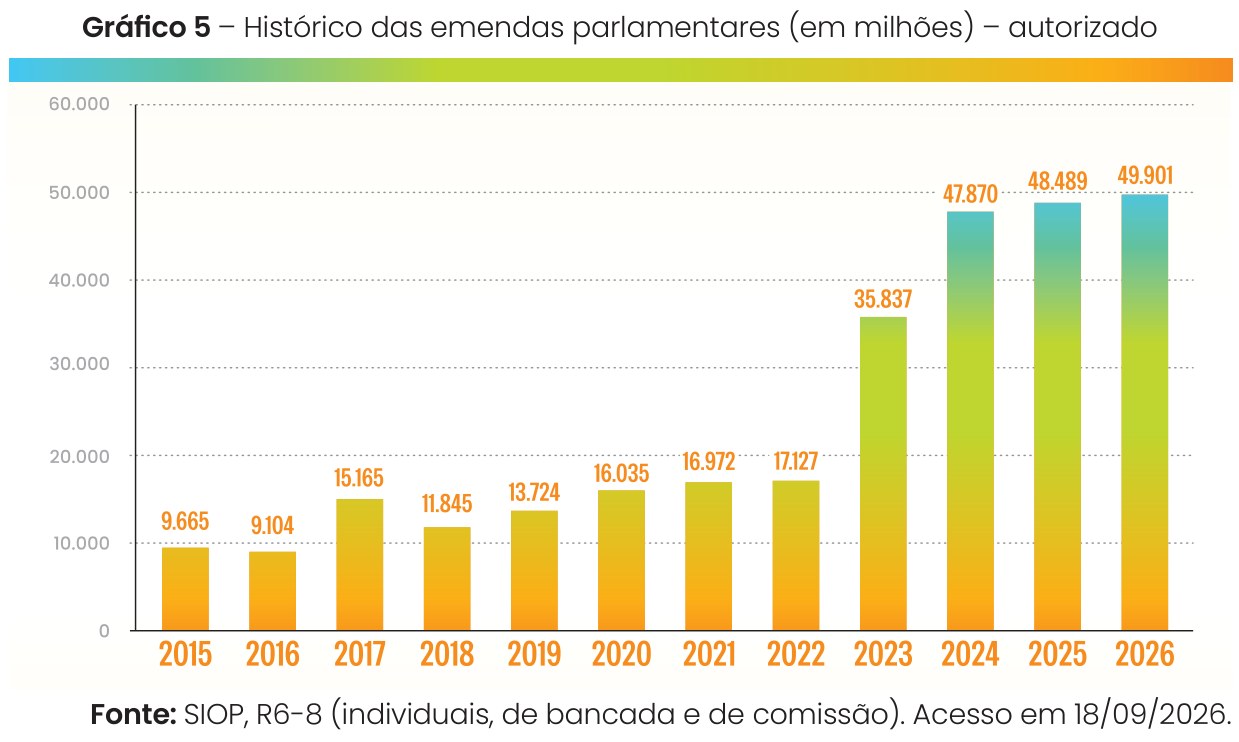
The report notes that this gives Congress more weight and reduces the Executive's room for decision. In 2024, amendments represented about 27% of the resources available for federal investment, and, when not tied to policy planning, they can fragment spending and hinder long-term actions.
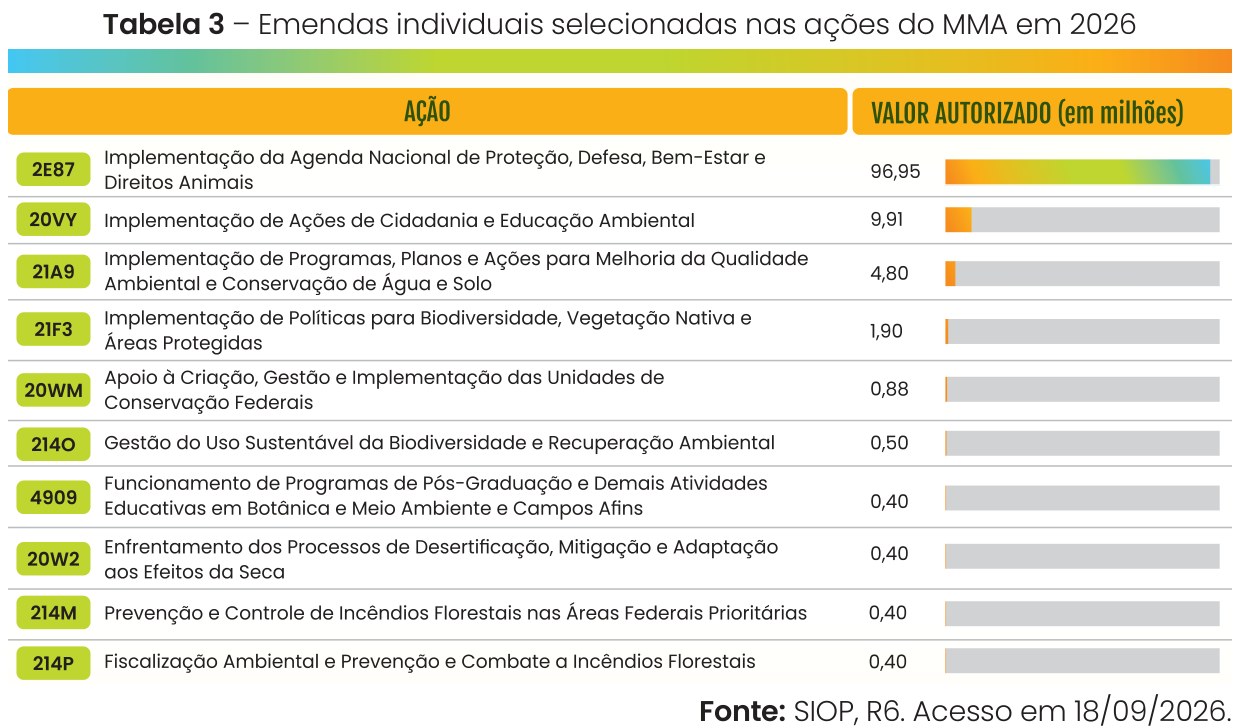
In the environmental area, the data the text highlights is the concentration of individual amendments in animal protection. The action for animal protection, defense, welfare and rights had R$78.53 million authorized in 2025 and R$96.95 million in 2026, the largest volume among the selected MMA actions. In 2026, that action accounted for 83% of the R$116.54 million in individual amendments to the listed actions. Environmental education had R$9.91 million, and environmental quality and water and soil conservation, R$4.8 million. The three actions add up to almost 96% of the total.
The amendments the report suggests
The final part of the report lists priority actions for amendments, with reference values 40% above what the bill provides, subject to each action's rules. The selection covers risk and disaster management, urban adaptation, access to water, civil defense, environmental enforcement, fire prevention and fighting, protected areas, the energy transition and actions that lost resources compared with 2026. Examples include Ibama's environmental control and enforcement (from R$240 million to R$336 million), civil protection and defense actions (from R$1.5 billion to R$2.1 billion), social technologies for rural water access (from R$700 million to R$980 million) and the non-reimbursable part of the Climate Fund for mitigation and adaptation studies and projects (from R$5.93 million to R$8.3 million).
What the numbers indicate
Three points recur throughout the document. The first is the form of financing: the bulk of the Climate Fund is credit, and the report links this to a lack of reach into vulnerable territories and municipalities with lower fiscal capacity. The second is concentration, with large companies ahead in approved operations and amendments grouped in a few actions. The third is execution: at the FNMA, what is planned is not always paid. The report sums up the challenge as getting resources to policies and territories, not just having more resources on paper.
For organizations, city governments and companies that depend on these funds, the practical consequence is to prepare projects that fit available lines and to follow the 2027 bill's passage and the amendments in Congress, where part of this design can still change.
Talk to KICK
KICK Group supports organizations in project design, socio-environmental diagnostics, stakeholder mapping and communication with communities. If your organization seeks climate or socio-environmental funding, it is worth talking.
Write to contato@kickgroup.com.br. Source: Observatório do Clima and Environmental Parliamentary Front, Budget 2027: Environment, Climate and Recommendations (October 2026) (in Portuguese). Charts and tables reproduced from the report, with credit. This text is informational and was updated as of November 5, 2026.