
The next wave of FPSOs in Brazil, Guyana and Suriname
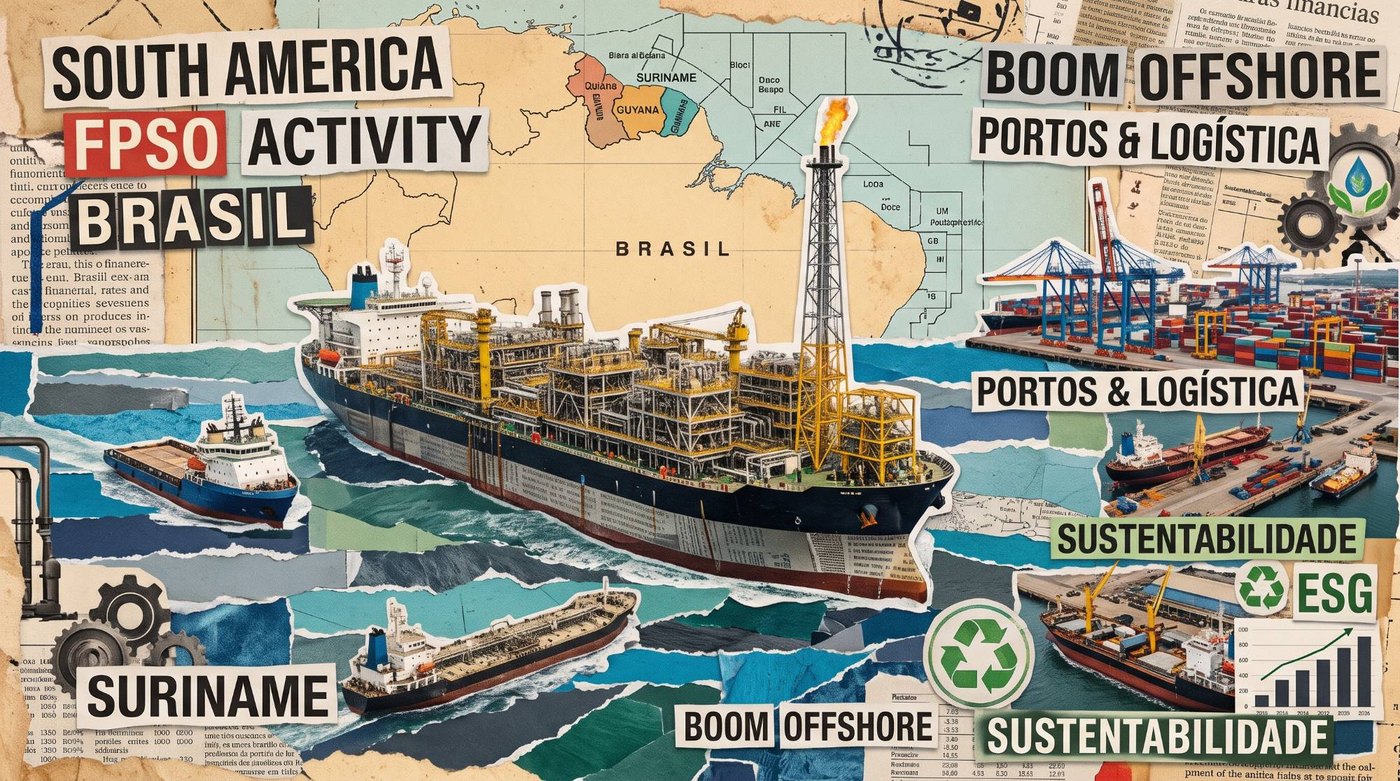
In Brazil, Petrobras keeps contracting and receiving floating platforms for the pre-salt. In Guyana, four units already take the Stabroek block's output to close to 900,000 barrels a day, and a fifth has just arrived. In Suriname, TotalEnergies is preparing the country's first major deepwater development. The common engine of these projects is the FPSO, and with it come questions about ESG indicators, rules, crises and the relationship with ports.
What it is about
FPSO stands for floating production, storage and offloading unit. It is a ship-shaped platform that receives oil and gas from wells on the seabed, separates oil, water and gas, stores the oil in its hull and transfers it to shuttle tankers. The arrangement is common in deep water, far from the coast, where sending everything to shore by pipeline would be unviable.
According to an analysis by Riviera Maritime Media, with data from Rystad Energy, 14 FPSOs were contracted worldwide between 2020 and 2024, six of them large units for the Búzios field in Brazil. This article covers three fronts: Brazil's pre-salt, the Stabroek block in Guyana and Block 58 in Suriname.
Brazil
Petrobras remains the main contractor. New units have entered Búzios since late 2025, according to the company, and two more, of 225,000 barrels a day each, are due in 2027, according to the Oil & Gas Journal. The contracts for the Atapu 2 and Sépia 2 platforms went to Seatrium, in a value of about US$8 billion. Outside Petrobras, Equinor is drilling the Raia gas project in the Campos Basin, with partners Repsol Sinopec and Petrobras, an investment of about US$9 billion and start-up planned for 2028, according to World Oil.
The new frontier is the Equatorial Margin. Ibama issued in October 2025 the license for Petrobras to drill the Morpho well at the mouth of the Amazon (in Portuguese), and any future production will depend on its own license.
Guyana
Four FPSOs produce in the Stabroek block, held by ExxonMobil (45%), Chevron (30%, which absorbed Hess) and CNOOC (25%): Liza Destiny, Liza Unity, Prosperity and One Guyana. Output was 895,000 barrels a day in May and 869,000 in June 2026, according to the Village Voice. The fifth, MODEC's Errea Wittu, arrived in Guyana in August for the Uaru project, with capacity of 250,000 barrels a day, gas treatment of 540 million cubic feet a day and a double hull, and is due to start operating in September, with first oil in the fourth quarter, according to Offshore Energy. Whiptail follows in 2027 and Hammerhead in 2029, and Longtail, a gas and condensate project, depends on a final investment decision this year.
Suriname
Block 58, operated by TotalEnergies with APA, had its final investment decision in October 2024, according to national oil company Staatsolie. The FPSO, of up to 220,000 barrels a day, will be built by SBM Offshore with Technip Energies, and first oil is expected in 2028. The unit was designed with an all-electric drive, to eliminate flaring, according to Riviera. On Block 52, Petronas plans a final decision on a gas project by the end of 2026, according to Brazil Energy Insight.
ESG and sustainability indicators
The sector reporting standard is GRI 11, for oil and gas, which lists 22 likely material topics, including greenhouse gas emissions, climate adaptation and transition, air emissions, biodiversity and water and effluents. The indicators tied to an FPSO project can be organized into six fronts.
- Climate and air: scope 1 and 2 emissions, carbon intensity per barrel, methane and volume flared. In Guyana, environmental permits prohibit routine flaring, and the count of flaring events became a point of dispute, according to InfoAmazonia. Suriname's FPSO was designed to eliminate flaring, and Uaru's uses a combined cycle to reduce CO₂.
- Water and waste: quality of discharged produced water, which at the Uaru FPSO has a capacity of 300,000 barrels a day, and the fate of drilling fluids and waste.
- Spills and readiness: number and volume of leaks, emergency plans and response equipment, such as the capping stack required in the permit for the Yellowtail project in Guyana.
- Safety: process safety events, accidents with and without lost time and results of management system audits.
- People and communities: local jobs and procurement, local content, grievance channels and engagement with fishing communities.
- Governance and end of life: financial guarantees, insurance and provisions for decommissioning.
Regulatory requirements
In Brazil, licensing is federal and run by Ibama. CONAMA Resolution 398/2008 sets the minimum content of the platform Individual Emergency Plan (in Portuguese) for oil pollution incidents. The ANP oversees operational safety. In August 2025, it shut down the Peregrino FPSO, in the Equinor and Prio field, after an audit of the safety management system, and Prio pointed to management and risk analysis documentation and adjustments to the deluge system as the main points, according to InfoMoney (in Portuguese). At the end of its life, ANP Resolution 817/2020 applies, on the decommissioning of facilities (in Portuguese), in line with Ibama's requirements.
In Guyana, each project receives its own environmental permit from the environmental agency, the EPA, with specific conditions. Yellowtail's, for example, prohibits routine flaring and venting, requires a capping stack kept in the country and a parent company guarantee, according to Stabroek News. Since December 2025, local insurers have been cleared to cover the block, according to Kaieteur News. The 2021 Local Content Act sets minimum local content levels and requires contractors to submit periodic reports, according to Stabroek News.
In Suriname, the environmental and social impact study for Block 58, with public consultations, was under review by the national environmental authority in 2024, according to SPE. The sources consulted do not confirm the current status, and it is worth checking before citing licensing as complete. Units also follow international maritime conventions, such as MARPOL, which CONAMA Resolution 398/2008 cites when addressing platforms.
The types of crisis
The operation of an FPSO can face at least six types of crisis, with recent examples below.
- Accident on board. On August 23, a fire in the accommodation laundry of the Liza Unity was quickly brought under control, with no injuries or spill reported. Oil transfer was suspended for checks, according to the Village Voice, and authorities are expected to investigate.
- Regulatory shutdown, like Peregrino's in 2025.
- Spill or irregular discharge, which triggers the emergency plan and public exposure of the company.
- Litigation and license disputes. In Guyana, gas flaring was taken to court, according to InfoAmazonia.
- Geopolitical crisis. Venezuela objected to the arrival of the One Guyana FPSO in the Stabroek block, in a maritime area it considers undelimited, according to Kaieteur News.
- Schedule and supply chain crisis, with yard delays and cost increases. Petrobras units, for example, go through yards abroad: P-84 is built in Yantai, China, and P-80 and P-82 are being integrated in Singapore, according to the Oil & Gas Journal.
In any of these scenarios, what the company communicates in the first hours and the relationships already in place with communities, authorities and the press weigh heavily.
How all this connects to ports
The FPSO sits at sea, but depends on land for logistics: support vessels, supplies, crew changes, waste reception, emergency response and, at the end, dismantling. That is why the projects cited also put pressure on bases and terminals.
In Brazil, Porto do Açu presents itself as the largest offshore support complex in the world (in Portuguese), and Guanabara Bay and Macaé concentrate bases serving the Santos and Campos basins. In Guyana and Suriname, infrastructure is being built alongside the projects. Offshore expansion drives the push for logistics hubs in the Caribbean, according to Caribbean Energy Week, and BNamericas points to Suriname as a target for an offshore supply base and possible energy hub, with environmental permitting of a base under way. For ports, this brings demand and brings requirements: licensing, capacity to receive vessel waste, emergency plans integrated with those of the platforms, local mobility and jobs and engagement with fishers and nearby communities.
What to watch
- The start-up of the Errea Wittu FPSO, in September, and Uaru's first oil in the fourth quarter.
- The outcome of the investigation into the Liza Unity fire.
- The final investment decisions on Longtail, in Guyana, and on Block 52, in Suriname.
- The new Búzios units, planned for 2027, and the progress of licensing in the Equatorial Margin.
Talk to KICK
KICK Group supports energy, port and logistics companies in organizing ESG data, mapping stakeholders, engaging with communities and preparing risk and crisis communication. If your business is linked to the offshore chain, it is worth talking.
Write to contato@kickgroup.com.br. Sources: Riviera, Oil & Gas Journal, Rigzone, World Oil, Exame, Offshore Energy, Village Voice, Stabroek News, Kaieteur News, InfoAmazonia, Staatsolie, SPE, Brazil Energy Insight, CONAMA, ANP, InfoMoney, GRI, Caribbean Energy Week and BNamericas. This text is informational, projects and dates may change and it was updated as of August 28, 2026.