

Brazil, China and BRICS arrive in Antalya with their own agendas and shared friction
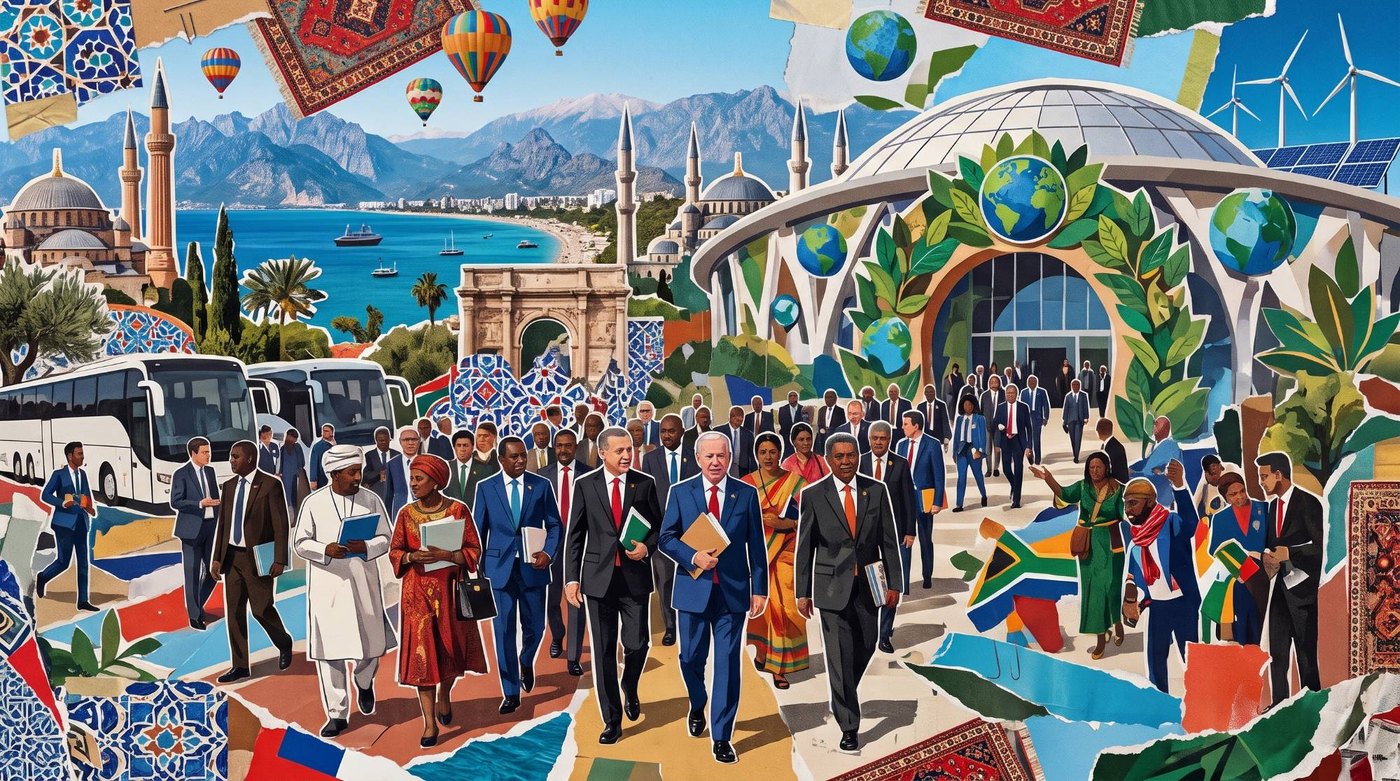
COP31 takes place from November 9 to 20, 2026, in Antalya, Türkiye, and the question circulating most among governments, companies and civil society is what the large emerging economies will bring to the table. Brazil, China and the other BRICS members arrive with their own agendas, partly overlapping and partly conflicting, at a moment when trade, finance and fossil fuels compete for the center of the negotiations.
What is confirmed so far
- Brazil's Presidency confirmed on October 30 that President Lula will attend, arriving on November 10 and taking part in the leaders' summit on November 11 and 12, accompanied by Health Minister Alexandre Padilha, according to U.S. News. The country will have its own pavilion in the Blue Zone, organized by the Ministry of Environment and Climate Change, the COP30 Presidency and Apex Brasil.
- China set out its priorities on October 21, at a press conference by Environment Vice-Minister Li Gao, according to Brazil Economy (in Portuguese). The sources consulted do not give the level of the Chinese delegation in Antalya.
- The Russian government announced it will open a pavilion at COP31, under the concept "Russia: territory of climate solutions," according to the Ministry of Economic Development. The composition of the delegation was not disclosed.
- India and South Africa have already presented their positions ahead of the conference, and Indian minister Bhupender Yadav led the country's delegation at the preparatory meeting (Pre-COP31) in Fiji.
For the other BRICS members, the sources consulted show no joint position of the bloc for COP31 and no consolidated confirmations of attendance. Agendas are individual, and coordination occurs mainly in groups such as BASIC, made up of Brazil, South Africa, India and China.
Brazil's program
The Brazil Pavilion will run from November 9 to 19, with two auditoriums, according to the program released by the Ministry (in Portuguese): the Belém Auditorium, focused on the national climate agenda, and the Global Mutirão Auditorium, tied to the Global Climate Action Agenda. The opening is set for November 9 at 5:45 p.m. The page lists the organizations proposing each panel, not the speakers, and times may change. Some highlights:
- Trade and geopolitics: "Trade and climate in the new world geopolitics" (Apex Brasil, 11/10) and "Climate, trade and resilience" (11/16).
- Fossil fuels: paths to a just transition beyond fossil fuels (UNEP, LACLIMA and Greenpeace Brazil, 11/10), the roadmap for the transition away from fossil fuels presented by the COP30 Presidency (11/11) and partnerships between exporters and importers with the OECD (11/13).
- Carbon markets: Article 6 and CORSIA, with IETA (11/11), implementation of the carbon market in Brazil, with the Ministry of Finance (11/13), and harmonization of carbon accounting (11/13).
- National agenda: launch of the IndicaClima System and the Climate Plan (11/12), zero deforestation by 2030, with Ibama and the Ministry (11/12), and the national Roadmap (11/12).
- Finance: the "Baku to Belém Roadmap to US$1.3 trillion" (11/14), sustainable finance with Banco do Brasil (11/10) and sessions on taxonomies, with the World Bank and the Ministry of Finance, and on risk management, with Febraban (11/13).
- Peoples and territories: Indigenous land tenure and climate goals, with MPI, APIB and TNC (11/13), Indigenous women and territorial defense (11/14) and climate justice and environmental racism (11/14).
- Productive sector: sessions by CNI, Febraban, CNT, CNA, CEBDS and other business associations throughout the week.
What China and Russia bring
According to Brazil Economy and Climate Home News, China wants to use COP31 to challenge trade barriers from the United States and the European Union and defends the free flow of green technologies. China is the largest maker of solar equipment, electric vehicles and batteries, and argues that tariffs make the transition more expensive. In an analysis by Carbon Brief, experts point to other priorities: reaffirming multilateralism, demanding delivery of finance, especially for adaptation, and emphasizing implementation of existing targets. There is also an expectation that the country will support electrification but resist linking it to the phase-out of fossil fuels. According to Brazil Economy, Brazil and China advanced in September on a memorandum on the carbon market, expected to be signed during COP31.
The Russian pavilion will have a different theme each day, covering the Arctic and the Northern Sea Route, urban resilience, carbon markets, energy (including renewables, small nuclear reactors and hydrogen), industry and CO₂ capture, food security, ecosystems and international cooperation, including within BRICS. Deputy Minister Vladimir Ilyichev argues that international climate rules should reflect differences in economic structures and energy mixes. Russia and the African Group also proposed a formal negotiating track on trade, according to Climate Home News.
What India and South Africa advocate
India ties greater ambition to finance, technology transfer and capacity-building, asks for equal weight on adaptation, mitigation and means of implementation, and defends the principle of common but differentiated responsibilities, according to the Pre-COP31 wrap-up. It also took Article 9.1 of the Paris Agreement, on finance from developed countries, to the provisional agenda.
South Africa prioritizes adaptation: it wants a benchmark to triple finance by 2035, operationalization of the Global Goal on Adaptation and adequate funding for loss and damage, and supports a Just Transition Mechanism, according to the Mail & Guardian. In June, in Bonn, BASIC said climate-related trade measures must not become arbitrary discrimination or a disguised restriction on trade, according to the South African government.
The main points of tension
- Tariffs and penalties on clean technologies and carbon-intensive products, such as the European Union's carbon border adjustment mechanism (CBAM), are expected to return to the center. In Belém, China, India and South Africa brought the topic to the agenda, and the European Union argues that the dialogue should not become a space for settling trade disputes, according to Climate Home News.
- The African Group asked for the agenda to include tripling adaptation finance, trade and the Green Climate Fund. The least developed countries want US$120 billion a year by 2030, and no other developing-country group has formally backed the request, according to Climate Home News. The conference may begin with a fight over the agenda.
- Exame reports that Turkish minister Murat Kurum, who chairs the summit and the Action Agenda, resists reaffirming the transition away from fossil fuels, while Australia's Chris Bowen, who leads the negotiations, favors abandoning them. Pacific islands demand explicit commitments, the subject of our text on climate finance in the region.
- In Bonn, China, India and Saudi Arabia questioned the basis of the 1.5 °C limit, and a coalition argued for decisions based on the best available science, according to Exame.
- It is the first COP with dual leadership, between Türkiye and Australia, and the design does not define who decides if the two presidencies diverge.
Civil society's expectations
The Observatório do Clima proposed the Antalya Call for fossil fuel transition roadmaps, a topic not on the official agenda, and the Climate Action Network, an international network of organizations, calls for the creation of the Belém-Antalya Mechanism for a global just transition, with participation of workers and communities, according to the ECO newsletter. The network also demands a formal path for adaptation finance, taxation of great fortunes and fossil profits, funds for loss and damage and attention to investor-state dispute settlement, which allows companies to sue countries over climate policies. Local organizations see limits on civil society participation in Türkiye, and the network records the detention of activists in Russia, a case also cited by Indigenous peoples.
The Brazil Pavilion's program gives these groups room. The Vituke Indigenous Fund, run by the Ministry of Indigenous Peoples and Funbio, has a session on November 10, and APIB takes part in the panel on Indigenous land tenure on November 13. On November 14, the Raoni Institute discusses the territorial defense of Indigenous women, and Geledés, religious communities in the climate agenda. PerifaConnection covers adaptation from the urban periphery (11/12), and the COP30 Youth Champion coordinates the Youth Mutirão (11/18). According to Exame, the COP30 Presidency proposes a "two-speed" multilateralism: consensus decisions define rules, and smaller coalitions deliver.
The market's expectations
The sources consulted show no consolidated surveys or positions from the private sector. Public signals point to four fronts:
- Trade and tariffs: how the dispute will affect solar, electric vehicle and battery chains and exported products with a carbon footprint.
- Carbon markets: Article 6 rules, interoperability among systems and the memorandum between Brazil and China.
- Finance and taxonomies: instruments that lower the cost of capital for the transition, the subject of several pavilion sessions.
- Action Agenda: according to Exame, the National Confederation of Industry created the Sustainable Business COP, which brings together more than 120 associations to guide Brazilian business participation.
What to watch in the coming weeks
- The setting of the provisional agenda and the fight over trade and adaptation in the first days.
- The leaders' summit, on November 11 and 12, and the speeches of Brazil, China, India and South Africa.
- The signing of the Brazil-China memorandum on the carbon market.
- The final text on fossil fuels and any reference to national roadmaps.
- What comes out of the Brazil Pavilion: the Climate Plan, the Roadmap and deforestation targets.
Talk to KICK
KICK Group follows the climate agenda and helps companies gauge how the negotiations affect ESG reporting, supplier chains, finance and communication. If COP31 may change something in your business, it is worth a conversation.
Write to contato@kickgroup.com.br. Sources: Ministry of Environment, Brazil Economy, Carbon Brief, Climate Home News (trade), Climate Home News (adaptation), Russian Ministry of Economic Development, Climate Action Network, Observatório do Clima, Exame, U.S. News, ANI, Mail & Guardian and South African government. This text is informational, programs may change, and it was updated as of November 3, 2026.